

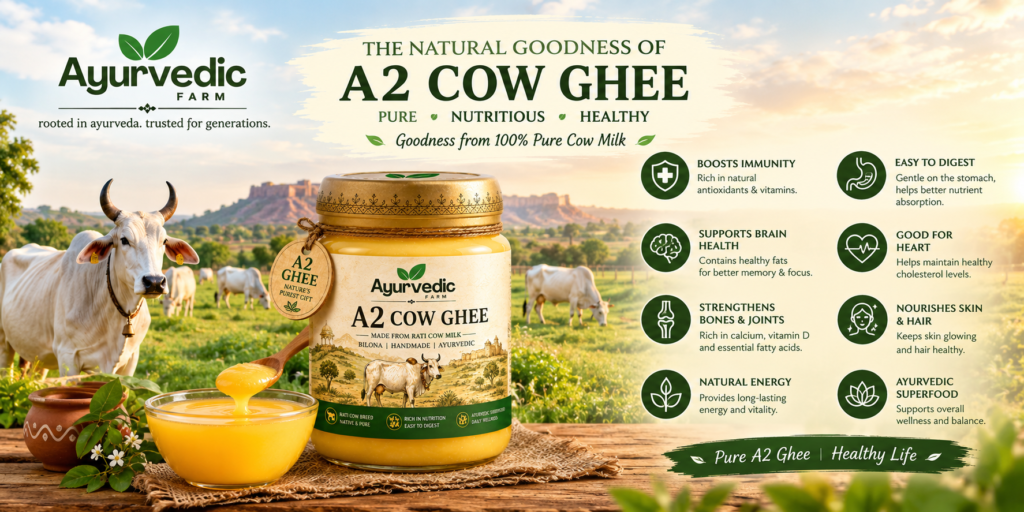
What is A2 cow ghee?
A2 cow ghee is clarified butter made from cow milk containing the A2 type of beta-casein protein. It is traditionally used in Indian cuisine and Ayurveda.
- Provides Healthy Fats – Ghee supplies dietary fat, which is an important source of energy and helps the body absorb fat-soluble vitamins.
- Supports Energy & Satiety – Its concentrated calories and fat can help make meals more satisfying.
- Helps Absorb Fat-Soluble Vitamins – Dietary fat supports absorption of vitamins A, D, E and K when they are present in the meal.
- Contains Butyrate – Ghee contains small amounts of butyrate, a short-chain fatty acid associated with gut and intestinal health.
- Supports Digestive Health – In traditional Ayurveda, ghee has long been used as part of dietary practices intended to support digestion.
- High-Heat Cooking Option – Ghee has a high smoke point, making it suitable for sautéing and many Indian cooking methods.
- May Support Heart-Healthy Eating When Used Moderately – Ghee can be part of a balanced diet, but because it is high in saturated fat, moderation is important.
- Supports Nutrient-Rich Traditional Diets – Ghee pairs well with foods such as dal, rice, roti and vegetables, helping add energy and flavor.
- Naturally Rich & Flavorful – Traditionally prepared cow ghee provides a distinctive aroma and taste without needing artificial flavoring.
- Traditional Ayurvedic Food – Cow ghee has an important place in traditional Indian and Ayurvedic food practices and has been consumed for generations.
1. What is A2 cow ghee?
A2 cow ghee is ghee made from cow milk associated with the A2 type of beta-casein protein. Ghee itself is produced by separating milk fat and removing most of the water and milk solids. A2 refers to the milk-protein type; it does not automatically mean the ghee has special medical benefits.
2. What are the benefits of cow ghee?
Cow ghee is a concentrated source of fat and energy. It can help with the absorption of fat-soluble vitamins A, D, E and K when consumed with foods containing them. Ghee also contains small amounts of short-chain fatty acids such as butyrate. Because it is calorie-dense and contains substantial saturated fat, moderation is important.
3. How is Bilona ghee made?
Traditional Bilona ghee is generally made by:
- Boiling and cooling cow milk.
- Adding a traditional starter culture to make curd.
- Churning the curd using the Bilona method.
- Separating the butter from the buttermilk.
- Heating the butter slowly to make ghee.
- Filtering and cooling the finished ghee.
4. A2 ghee vs regular ghee
The main distinction is related to the milk used to make the ghee. A2 terminology refers to the beta-casein type in the source milk. However, most of the milk proteins are removed during ghee preparation, so claims that A2 ghee itself provides dramatically different health effects from ordinary cow ghee should be treated cautiously.
5. How much ghee should you consume daily?
There is no single ideal amount for everyone. Ghee should be considered part of your total daily fat intake. A small serving incorporated into a balanced diet is generally more appropriate than consuming large quantities. Individual needs vary according to overall diet, calorie requirements and health circumstances.
6. How to identify pure cow ghee?
You cannot reliably prove purity simply by looking at color, smell or texture. For packaged ghee, check the ingredient list, FSSAI details, manufacturer information, batch information and quality/testing documentation. Laboratory testing is much more reliable than home “purity tests.”
7. What is the traditional Bilona method?
The Bilona method is a traditional Indian process in which milk is first converted into curd, the curd is churned to obtain butter, and the butter is then heated to produce ghee. It differs from methods that directly process cream or milk fat into ghee.