

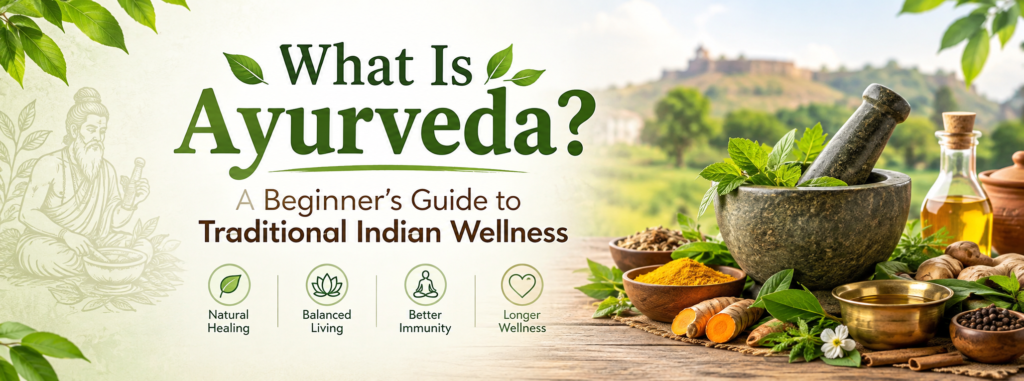
What Is Ayurveda? A Beginner’s Guide to Traditional Indian Wellness
In today’s fast-paced world, many people are looking for simpler and more natural ways to support their overall well-being. This growing interest has brought renewed attention to Ayurveda, India’s traditional system of health and wellness.
But what exactly is Ayurveda? Is it simply about herbal remedies and spices? Or is it a broader way of understanding food, lifestyle, daily routines and overall balance?
The answer is much broader.
Ayurveda is a traditional Indian system of health knowledge that takes a holistic view of well-being. Its approach considers the individual, including diet, lifestyle, daily habits, environment and the relationship between the body and mind.
In this beginner’s guide, let us understand the basic ideas behind Ayurveda and how its principles can be appreciated in modern everyday life.
What Is Ayurveda?
The word Ayurveda comes from two Sanskrit words:
- Ayur – life
- Veda – knowledge or science
Therefore, Ayurveda is commonly understood as the “knowledge of life.”
Rather than focusing only on illness, Ayurveda traditionally places considerable importance on maintaining health and supporting a balanced way of living.
The Ministry of Ayush describes Ayurveda as an ancient and comprehensive system of health care with a documented history extending back more than 5,000 years. Classical Ayurvedic texts such as the Charaka Samhita and Sushruta Samhita played an important role in organizing Ayurvedic knowledge.
Today, Ayurveda remains an important part of India’s traditional health heritage and is also receiving interest internationally. The World Health Organization has published international terminology and practice benchmarks relating to Ayurveda.
Ayurveda Is More Than Herbal Remedies
One common misconception is that Ayurveda simply means using herbs or drinking herbal preparations.
In reality, the traditional Ayurvedic approach is much broader.
It can include ideas related to:
- Food and dietary habits
- Daily routines
- Seasonal routines
- Sleep and rest
- Physical activity
- Personal hygiene
- Herbs and traditional preparations
- Yoga and meditation
- Mental and emotional well-being
- Maintaining balance between the individual and their environment
This holistic approach is one reason Ayurveda continues to attract interest among people looking for a more mindful approach to everyday wellness.
The Ayurvedic Concept of Balance
A central idea in Ayurveda is balance.
According to traditional Ayurvedic philosophy, the body and mind are influenced by different functional principles known as the three doshas:
1. Vata
Vata is traditionally associated with movement and is connected with qualities such as air and space.
2. Pitta
Pitta is traditionally associated with transformation and is connected with the elements of fire and water.
3. Kapha
Kapha is traditionally associated with stability and structure and is connected with water and earth.
Ayurveda considers these principles when describing an individual’s constitution and lifestyle.
However, it is important to remember that Ayurvedic concepts such as doshas belong to the traditional Ayurvedic framework and should not automatically be interpreted as equivalent to modern medical physiology.
Why Is Food Important in Ayurveda?
Food has always had an important place in Ayurvedic traditions.
The traditional approach does not consider food merely as a source of calories. It also considers the quality of food, preparation methods, timing and individual needs.
This philosophy makes everyday ingredients particularly interesting.
Indian kitchens have traditionally used ingredients such as:
- Turmeric
- Cumin
- Coriander
- Black pepper
- Ginger
- Fenugreek
- Fennel
- Sesame
- Garlic
These ingredients are valued in Indian culinary traditions for their distinctive aroma, flavour and cultural significance.
Traditional Spices and Everyday Cooking
For generations, Indian households have ground and blended spices to prepare fresh food.
Traditional methods such as stone grinding can create aromatic spice powders with distinctive textures and flavours. Ingredients such as turmeric, coriander, cumin and chilli are not only important parts of Indian cuisine but also represent India’s long culinary heritage.
At AyurvedicFarm, we believe that understanding where food comes from and how it is traditionally prepared can make everyday eating more meaningful.
Ayurveda and Daily Routine
Ayurveda also places importance on daily routines, often referred to as Dinacharya in traditional literature.
The basic idea is simple: healthy habits become more sustainable when they are incorporated into everyday life.
A modern interpretation could include:
- Maintaining regular meal times
- Getting adequate sleep
- Staying physically active
- Spending time outdoors
- Eating a varied and balanced diet
- Practising mindful eating
- Maintaining personal hygiene
- Taking time to relax
- Building consistent daily habits
These are not complicated ideas. In fact, many of them are simple habits that people can incorporate into modern life.
Ayurveda and Seasonal Living
Another important traditional Ayurvedic concept is adapting lifestyle and food habits according to the seasons.
For example, our food preferences naturally change with weather. During colder months, many Indian households traditionally prepare warming foods and use spices such as ginger, cumin and black pepper. During warmer periods, lighter foods and refreshing preparations may become more common.
This seasonal awareness reflects a broader Ayurvedic idea: our lifestyle does not exist separately from nature and our surroundings.
Ayurveda and Natural Ingredients
Plants, herbs, spices and other natural materials have been part of Ayurvedic traditions for centuries.
However, one important point should be remembered:
Natural does not automatically mean safe for everyone.
The Ministry of Ayush’s Ayush Suraksha programme specifically highlights the importance of safety monitoring and cautions against the belief that everything natural is automatically safe. Traditional medicines and concentrated herbal preparations can have side effects or interact with other medicines.
Therefore, if you are considering an Ayurvedic medicine, supplement or therapeutic treatment for a health condition, it is sensible to consult a qualified healthcare professional or appropriately trained Ayurvedic practitioner.
Ayurveda in Modern Life
Modern life often involves long working hours, processed foods, irregular sleep and limited time for relaxation.
This is one reason people are increasingly interested in traditional approaches that emphasize balance, routine and mindful living.
You do not necessarily need to completely change your lifestyle to appreciate Ayurvedic principles.
You can start with small steps:
Eat Mindfully
Pay attention to what you eat and how your food is prepared.
Choose Quality Ingredients
Fresh, responsibly sourced ingredients can make everyday cooking more enjoyable.
Use Spices Traditionally
Experiment with traditional Indian spices to add natural flavour and aroma to your meals.
Maintain a Routine
Try to establish consistent times for sleeping, eating and physical activity.
Respect Your Individual Needs
There is no single diet or lifestyle that works exactly the same way for everyone.
Ayurveda and Indian Food Heritage
Ayurveda is deeply connected with India’s food culture.
Across India, different regions have developed their own traditional foods, spices and preparation techniques.
From Rajasthan’s traditional spice blends and ker sangri to South India’s use of curry leaves and spices, India’s culinary diversity reflects centuries of local knowledge and adaptation.
Traditional food is therefore not simply about recipes. It also tells a story about people, geography, climate, agriculture and generations of knowledge.
This is particularly meaningful in Rajasthan, where traditional ingredients and food preservation techniques developed in response to the region’s dry climate.
Ayurveda vs Modern Medicine
Ayurveda and modern medicine come from different knowledge systems and should not be presented as interchangeable.
Modern medicine is based on contemporary biomedical science, clinical research and evidence-based medical practice.
Ayurveda is a traditional system with its own concepts, terminology and practices.
Today, there is growing international interest in studying traditional medicine using scientific research methods. WHO’s work on traditional medicine emphasizes the importance of evidence, safety, quality and appropriate regulation.
For serious, persistent or emergency health problems, professional medical care should never be delayed in favour of a home remedy.
How Can a Beginner Start Exploring Ayurveda?
If you are completely new to Ayurveda, you do not need to learn everything at once.
Start with the basics.
Step 1: Understand your food.
Learn about the spices, grains, oils, herbs and traditional ingredients commonly used in your kitchen.
Step 2: Improve your daily routine.
Focus on regular sleep, balanced meals, movement and adequate rest.
Step 3: Learn traditional concepts.
Explore ideas such as doshas, Prakriti, Agni and Dinacharya through reliable sources.
Step 4: Understand your ingredients.
Learn how traditional Indian ingredients have been used historically and culturally.
Step 5: Be responsible with remedies.
Do not self-treat serious medical conditions or assume that a herbal product is automatically safe simply because it is natural.
Ayurveda: An Ancient Tradition for a Mindful Lifestyle
Ayurveda is much more than a collection of herbs or home remedies.
At its heart is a traditional Indian understanding of life, balance, food, routine and well-being.
Its continued popularity comes partly from the fact that many of its everyday themes—mindful eating, regular routines, connection with nature and awareness of individual needs—remain relevant to modern life.
For beginners, the best way to explore Ayurveda is with curiosity and balance: appreciate its rich traditional knowledge while also understanding the importance of modern scientific evidence and professional healthcare.
At AyurvedicFarm, we believe that traditional food knowledge deserves to be understood, preserved and shared with the next generation.
From traditionally valued spices and oils to regional Indian foods, our goal is to celebrate the connection between nature, traditional food and everyday living.
Discover the Wisdom of Traditional Indian Food
Explore AyurvedicFarm to learn more about traditional Indian ingredients, spices, oils, pickles, ghee and regional foods rooted in India’s rich culinary heritage.
AyurvedicFarm — rooted in ayurveda. trusted for generations.
Frequently Asked Questions
Is Ayurveda only about medicines?
No. Ayurveda is a broader traditional health system that includes concepts related to diet, lifestyle, daily routines, herbs, preventive approaches and overall well-being.
Is Ayurveda Indian?
Yes. Ayurveda originated in the Indian subcontinent and has a long documented history within India’s traditional systems of knowledge.
Can anyone follow an Ayurvedic lifestyle?
Many general lifestyle practices—such as eating mindfully, maintaining a regular routine and staying physically active—can be incorporated into everyday life. However, individualized Ayurvedic treatment should be discussed with a qualified practitioner.
Are Ayurvedic products always safe because they are natural?
No. Natural products can still cause adverse effects or interact with medicines. Safety depends on the particular product, dose, preparation, quality and individual circumstances.
Is Ayurveda scientifically proven?
Ayurveda contains a large traditional knowledge base, and research into Ayurvedic practices and products continues. The evidence varies significantly depending on the specific treatment or product, so individual health claims should be evaluated carefully. The Ministry of Ayush maintains research resources, while WHO has developed terminology and practice benchmarks for Ayurveda.
Final Thought
Ayurveda invites us to look at wellness from a broader perspective—not just as the absence of illness, but as a thoughtful relationship between food, lifestyle, environment and everyday habits.
Its ancient roots provide a fascinating window into India’s traditional understanding of health and living, while modern research can help us better understand which practices are safe and effective today.
Sometimes, returning to simple habits is the first step toward a more mindful way of living.